
HomeScience & EnvironmentStone tool discovery suggests...

Stone tool discovery suggests very first humans were inventors

Pallab Ghosh profile image

Pallab GhoshScience Correspondent

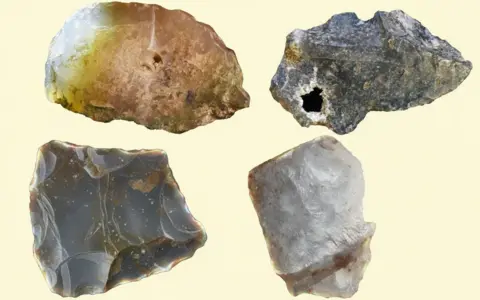
David Braun Composite image of four stone tools on a pale yellow background. The top left stone displays a rich blend of golden and earthy hues with a polished appearance and distinct surface features. The top right stone is darker, rugged, and features a prominent cavity, giving it a unique and weathered character. The bottom right stone appears translucent and pearlescent, with gentle gradients of white and pale brown that highlight its smooth fractured surfaces. The bottom left stone stands out with glassy reflections, angular facets, and traces of ancient flaking visible against its blue-grey background.David Braun

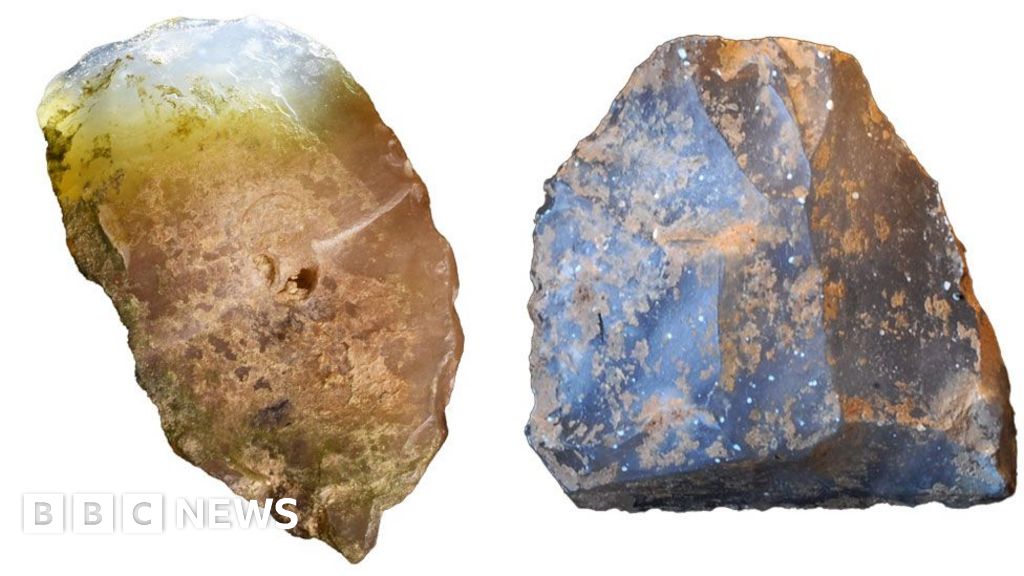
They look like simple stones, but they were state of the art tools millions of years ago, made with great skill and precison

The very first humans millions of years ago may have been inventors, according to a discovery in northwest Kenya.

Researchers have found that the primitive humans who lived 2.75 million years ago at an archaeological site called Namorotukunan used stone tools continuously for 300,000 years.

Evidence previously suggested that early human tool use was sporadic: randomly developed and quickly forgotten.

The Namorotukunan find is the first to show that the technology was passed down through thousands of generations.

According to Prof David Braun, of George Washington University, in Washington DC, who led the research, this find, published in the journal Nature Communications, provides incredibly strong evidence for a radical shake-up in our understanding of human evolution.

“We thought that tool use could have been a flash in the pan and then disappeared. When we see 300,000 years of the same thing, that’s just not possible,” he said.

“This is a long continuity of behaviour. That tool use in (humans and human ancestors) is probably much earlier and more continuous than we thought it was.”
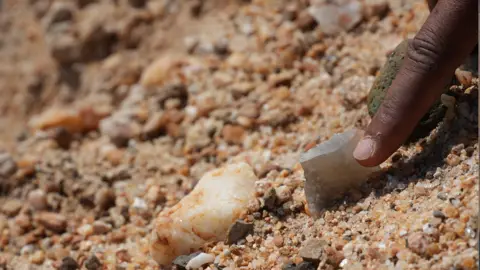
David Braun A person's hand is pointing to or holding a sharp stone tool that is partially buried in sandy, gravelly ground. The scene is very close up, showing the texture of the dirt and small rocks around the tool. The focus suggests the discovery or examination of a potential artifact, likely during an archaeological dig.David Braun

The stone tools were so sharp that the researchers could cut their fingers on some of them

Archaeologists spent ten years at Namorotukunan uncovering 1,300 sharp flakes, hammerstones, and stone cores, each made by carefully striking rocks gathered from riverbeds. These are made using a technology known as Oldowan and is the first widespread stone tool-making method.

The same kinds of tools appear in three distinct layers. The deeper the layer the further back the snapshot in time. Many of the stones were specially chosen for their quality, suggesting that the makers were skilled and knew exactly what they were looking for, according to the senior geoscientist on the research team, Dr Dan Palcu Rolier of the University of São Paulo in Brazil.

“What we see here in the site is an incredible level of sophistication,” he told BBC News.

“These guys were extremely astute geologists. They knew how to find the best raw materials and these stone tools are exceptional. Basically, we can cut our fingers with some of them.”

Geological evidence suggests that tool use probably helped these people survive dramatic changes in climate.

The landscape shifted from lush wetlands to dry, fire-swept grasslands and semideserts,” said Rahab N. Kinyanjui, senior scientist at the National Museums of Kenya.
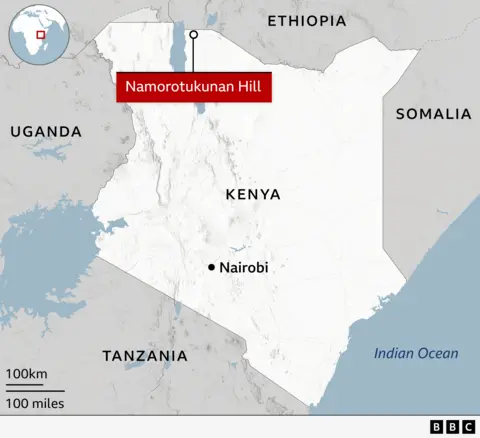
Map of Kenya in East Africa, surrounded by Uganda to the west, Tanzania to the south, Ethiopia to the north, and Somalia to the east, with the Indian Ocean on its southeast coast. The map highlights a specific location named Namorotukunan Hill in northwestern Kenya, almost on the border with Ethiopia. Nairobi, the capital city of Kenya, is marked further south in the middle of the country. A small inset globe at the top left corner displays Kenya's position within Africa.

These sharp environmental changes would normally force animal populations to adapt through evolution or move away. But the toolmakers in the region managed to thrive by using technology rather than biological adaptation, according to Dr Palcu Rolier.

“Technology enabled these early inhabitants of East Turkana to survive in a rapidly changing landscape – not by adapting themselves, but adapting their ways of finding food.”

The evidence of stone tools at different layers shows that for a long and continuous period, these primitive people flew in the face of biological evolution, finding a way of controlling the world around them, rather than letting the world control them.

And this happened at the very beginning of the emergence of humanity, according to Dr Palcu Rolier.

“Tool use meant that they did not have to evolve by modifying their bodies to adapt to these changes. Instead, they developed the technology they needed to get access to the food: tools for ripping open animal carcasses and digging up plants.”
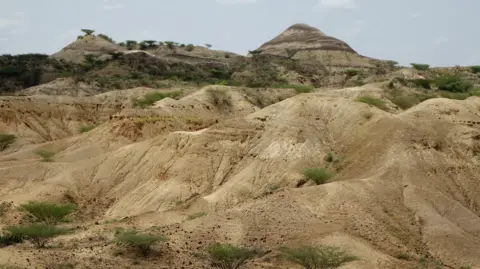
David Braun The picture shows a broad, arid landscape of tan and sandy hills with gentle slopes and eroded gullies, dotted with small green shrubs and sparse trees. In the background, there are a few dome-shaped hills and patches of vegetation, beneath a pale blue sky with scattered, wispy white clouds. The overall scene is dry and rugged, evoking a sense of ancient terrain shaped by long-gone water flowsDavid Braun

The Namorotukunan site, located in Kenya’s Turkana Basin, lies close to the ancient course of a long dried up major river which once attracted settlements of early humans and their ancestors

There is evidence for this at the site: of animal bones being broken, being cut with these stone tools, which means that through these changes, they were consistently able to use meat as a way of sustenance.

“The technology gives these early inhabitants an advantage, says Dr Palcu Rolier.

“They are able to access different types of foods as environments change, their source of sustenance is changing, but because they have this technology, they can bypass these challenges and access new food.”
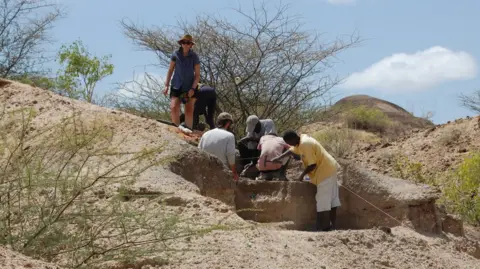
David Braun A group of people are working together at an archaeological dig site in a dry, rocky landscape with sparse vegetation. Some are kneeling and carefully examining or excavating a partially exposed layer of earth, while one stands nearby watching. Their focused activity suggests they are searching for or studying artifacts or fossils in the ground.David Braun

Archaeologists excavate a 2.58 million year old site in northern Kenya at the site of Namorotukunan

At around 2.75 million years ago, the region was populated by some of the very first humans, who had relatively small brains. These early humans are thought to have lived alongside their evolutionary ancestors: a pre-human group, called australopithecines, who had larger teeth and a mix of chimpanzee and human traits.

The tool users at Namorotukunan were most likely one of these groups or possibly both.

And the finding challenges the notion held by many experts in human evolution that continuous tool use emerged much later, between 2.4 and 2.2 million years ago, when humans had evolved relatively larger brains, according to Prof Braun.

“The argument is that we’re looking at a pretty substantial brain size increase. And so, often the assertion has been that tool use allowed them to feed this large brain.

“But what we’re seeing at Namorotukunan is that these really early tools are used before that brain size increase.”

“We have probably vastly underestimated these early humans and human ancestors. We can actually trace the roots of our ability to adapt to change by using technology much earlier than we thought, all the way to 2.75 million years ago, and probably much earlier.”


Source link

- A word from our sponsors -

spot_img

Most Popular

More from Author

Why This Glacier Worries Scientists the Most

new video loaded: Why This Glacier Worries Scientists the MostOur climate...

Stock Market Holidays 2026: Are NSE, BSE Open Or Closed On December 31, January 01? | Markets News

Last Updated:December 30, 2025, 16:01 ISTWill NSE and BSE remain open...

What is happening to gas and electricity prices?

Getty ImagesTypical household energy costs will increase slightly on Thursday when...

- A word from our sponsors -

spot_img

Read Now

Rupee outlook 2026: Why the rupee may stay under stress next year; here’s what experts say

The Indian rupee is set to face sharp and persistent volatility through 2026 as capital outflows, tariff-related trade disruptions and weak foreign investment flows continue to outweigh the country’s strong macroeconomic fundamentals, analysts and official data indicate, PTI reported.Despite steady growth and moderate inflation at...

Why This Glacier Worries Scientists the Most

new video loaded: Why This Glacier Worries Scientists the MostOur climate reporter Raymond Zhong describes how the fast-melting Thwaites Glacier of Antarctica, is like a cork in a bottle: If it starts to really disintegrate, many more glaciers around it could do the same, with major consequences...

Stock Market Holidays 2026: Are NSE, BSE Open Or Closed On December 31, January 01? | Markets News

Last Updated:December 30, 2025, 16:01 ISTWill NSE and BSE remain open on December 31 and January 1 in 2026? Check NSE, BSE holidays list for 2026?NSE Holiday 2026: Will stock market be closed on New Year? NSE Holidays 2026: As the calendar flips and investors step into...

What is happening to gas and electricity prices?

Getty ImagesTypical household energy costs will increase slightly on Thursday when the new energy price cap takes effect. Separately, the regulator Ofgem has said customer bills will rise by around £30 a year over the next six years to help fund a major investment in the UK's...

Who Is Ruby Franke? The rise and fall of the family vlogger convicted of child abuse

Your support helps us to tell the storyFrom reproductive rights to climate change to Big Tech, The Independent is on the ground when the story is developing. Whether it's investigating the financials of Elon Musk's pro-Trump PAC or producing our latest documentary, 'The A Word', which shines...

Blue Origin astronaut reveals depression after space flight backlash

A Vietnamese-American astronaut has opened up about her depression after she received a "tsunami of harassment" following the first all-female space trip since 1963 earlier this year.Amanda Nguyen - a 34-year-old scientist and civil rights activist - was part of the 11-minute Blue Origin space flight, which...

Beyoncé is now a billionaire, according to Forbes

Beyoncé once said, "It should cost a billion to look this good," and now she can afford it. The Grammy-winning artist is now a billionaire, becoming the fifth...

India’s FDI squeeze – India Today

One of the narratives of the Bharatiya Janata Party on the eve of the general election in May-June this year was that India, under the Narendra Modi government, was beginning to claim her rightful place in the world. It was growing at 7 per cent, was...

GM’s record stock performance beats Tesla, Ford in 2025

Mary Barra, CEO of General Motors, attends the annual Allen and Co. Sun Valley Media and Technology Conference at the Sun Valley Resort in Sun Valley, Idaho, on July 8, 2025.David A. Grogan | CNBCDETROIT — General Motors is on pace to be the top U.S.-traded automaker...

The biggest health myths we finally stopped believing in 2025 |

Sometimes long held beliefs are tested when science weighs in. Whether these are theories or claims, emerging studies and research are consistently separating the facts from myths. When it came to health myths this year, scientific evidence has put a stop to some of them....

700Credit data breach exposes 5.8 million people’s Social Security numbers

NEWYou can now listen to Fox News articles! Data breaches tied to financial services companies are no longer rare, but they still hit harder when Social Security numbers are involved. In the latest incident, U.S.-based fintech company 700Credit has confirmed that the personal data of...

Adam Peaty ‘in tears’ as Holly Ramsay walks down the aisle

Adam Peaty was moved to tears when Holly Ramsay walked down the aisle at their wedding ceremony on December,...