HomeScience & EnvironmentTiny creature gorges, gets...

Tiny creature gorges, gets fat, and locks up planet-warming carbon

Georgina Rannard

Climate and science correspondent
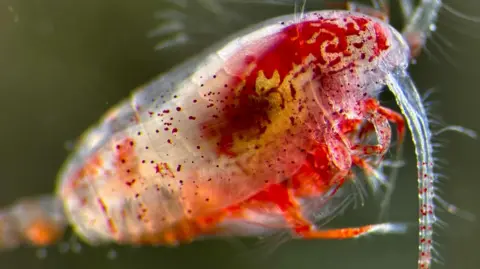
Prof Daniel J Mayor @oceanplankton A close-up of the head of the copepod, Calanus propinquus, showing its bright red antennae and hair-like feeding appendages.Prof Daniel J Mayor @oceanplankton

A tiny, obscure animal often sold as aquarium food has been quietly protecting our planet from global warming by undertaking an epic migration, according to new research.

These “unsung heroes” called zooplankton gorge themselves and grow fat in spring before sinking hundreds of metres into the deep ocean in Antarctica where they burn the fat.

This locks away as much planet-warming carbon as the annual emissions of roughly 55 million petrol cars, stopping it from further warming our atmosphere, according to researchers.

This is much more than scientists expected. But just as researchers uncover this service to our planet, threats to the zooplankton are growing.

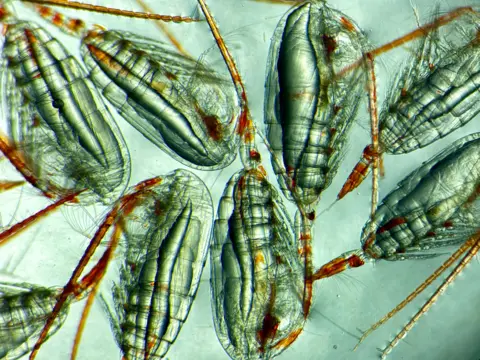
Prof Daniel J Mayor @oceanplankton Female copepods (Calanus simillimus) displaying variable quantities of lipid (fat) reserves – the clear cigar shaped ‘bubble’ within their bodies. Body length approximately 4mm.Prof Daniel J Mayor @oceanplankton

Female copepods (4mm) with cigar-shaped fat stores in their bodies

Scientists have spent years probing the animal’s annual migration in Antarctic waters, or the Southern Ocean, and what it means for climate change.

The findings are “remarkable”, says lead author Dr Guang Yang from the Chinese Academy of Sciences, adding that it forces a re-think about how much carbon the Southern Ocean stores.

“The animals are an unsung hero because they have such a cool way of life,” says co-author Dr Jennifer Freer from British Antarctic Survey.

But compared to the most popular Antarctic animals like the whale or penguin, the small but mighty zooplankton are overlooked and under-appreciated.
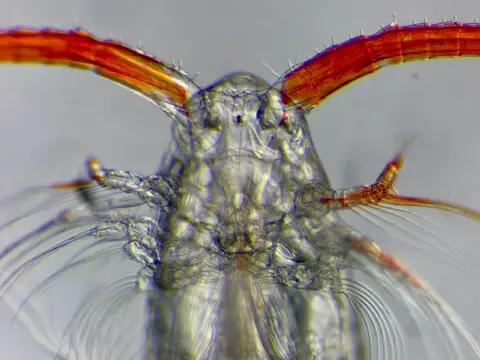
Prof Daniel J Mayor @oceanplankton A close-up of the head of the copepod, Calanus propinquus, showing its bright red antennae and hair-like feeding appendages.Prof Daniel J Mayor @oceanplankton

This copepod has hair-like arms for feeding

If anyone has heard of them, it’s probably as a type of fish food available to buy online.

But their life cycle is odd and fascinating. Take the copepod, a type of zooplankton that is a distant relative of crabs and lobsters.

Just 1-10mm in size, they spend most of their lives asleep between 500m to 2km deep in the ocean.
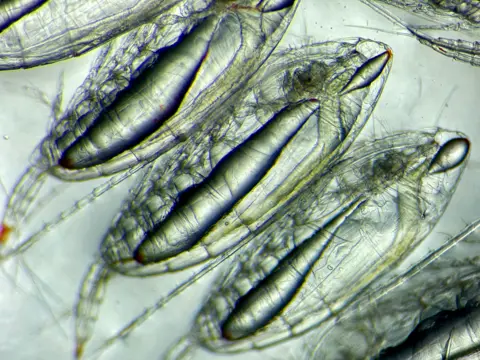
Prof Daniel J Mayor @oceanplankton The Southern Ocean copepod, Calanoides acutus, with their green pigmented guts and lipid sacs clearly visible inside its transparent body. Body length approximately 4mm.Prof Daniel J Mayor @oceanplankton

Sacs of fat, or lipids, form in Southern Ocean copepods’ bodies and heads after they eat phytoplankton (the green material in the bodies in this image)

In pictures taken under a microscope, you can see long sausages of fat inside their bodies, and fat bubbles in their heads, explains Prof Daniel Mayor who photographed them in Antarctica.

Without them, our planet’s atmosphere would be significantly warmer.

Globally the oceans have absorbed 90% of the excess heat humans have created by burning fossil fuels. Of that figure, the Southern Ocean is responsible for about 40%, and a lot of that is down to zooplankton.
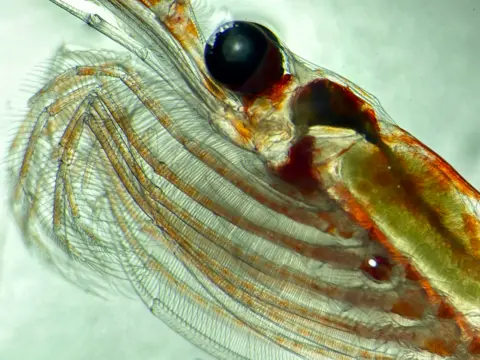
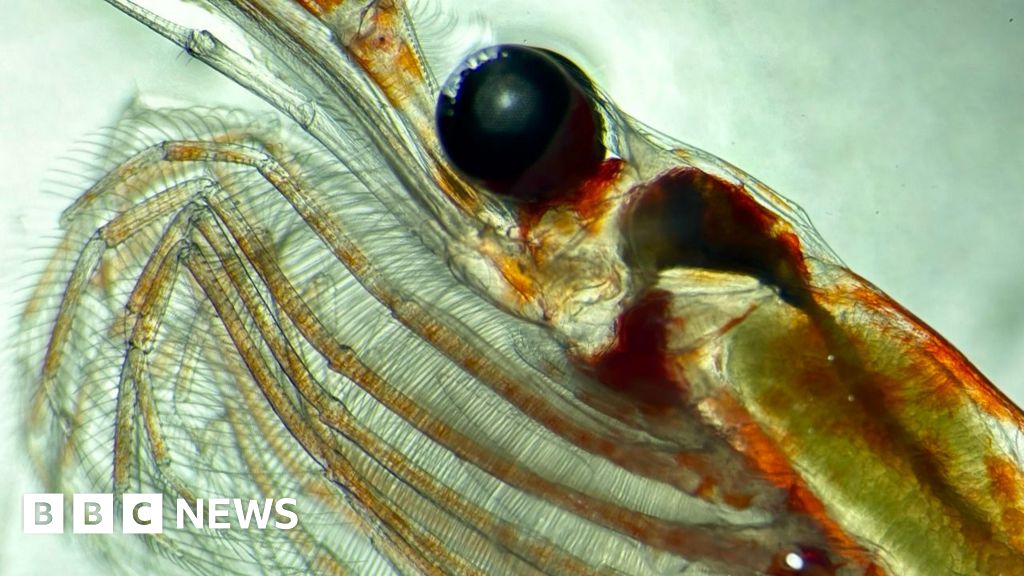
Prof Daniel J Mayor @oceanplankton A close-up of Antarctic krill, Euphausia superba, showing its specialised front limbs (the ‘feeding basket’) that help them harvest microscopic phytoplankton (algae) from the water. Its green gut demonstrates their effectiveness. It has orange patches in his body and front legs, with a large black eye at the top of its body. Prof Daniel J Mayor @oceanplankton

Millions of pounds is being spent globally to understand how exactly they store carbon.

Scientists were already aware that the zooplankton contributed to carbon storage in a daily process when the animals carbon-rich waste sinks to the deep ocean.

But what happened when the animals migrate in the Southern Ocean had not been quantified.

The latest research focussed on copepods, as well as other types of zooplankton called krill, and salps.

The creatures eat phytoplankton on the ocean surface which grow by transforming carbon dioxide into living matter through photosynthesis. This turns into fat in the zooplankton.

“Their fat is like a battery pack. When they spend the winter deep in the ocean, they just sit and slowly burn off this fat or carbon,” explains Prof Daniel Mayor at University of Exeter, who was not part of the study.

“This releases carbon dioxide. Because of the way the oceans work, if you put carbon really deep down, it takes decades or even centuries for that CO2 to come out and contribute to atmospheric warming,” he says.
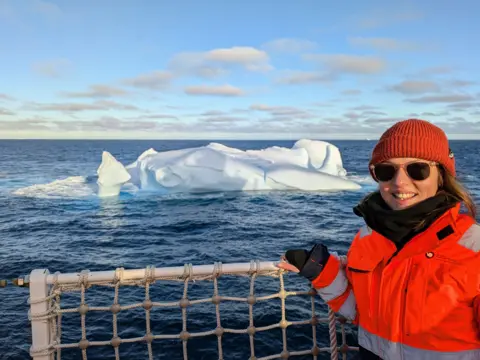
Jennifer Freer Dr Jennifer Freer stands on deck of the Sir David Attenborough polar ship wearing orange high-vis safety clothing, a red hat and sunglasses. She is holding on to the rope railing next to the ocean. Close to the ship is the tip of an iceberg visible at the water surface. The sky is blue with some clouds.Jennifer Freer

Dr Jennifer Freer analysed the zooplankton on board the Sir David Attenborough polar ship

The research team calculated that this process – called the seasonal vertical migration pump – transports 65 million tonnes of carbon annually to at least 500m below the ocean surface.

Of that, it found that copepods contribute the most, followed by krill and salps.

That is roughly equivalent to the emissions from driving 55 million diesel cars for a year, according to a greenhouse gas emissions calculator by the US EPA.
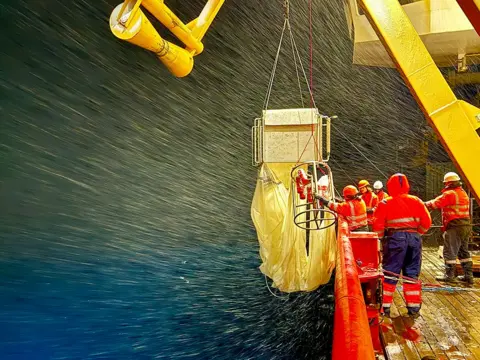
Prof Daniel J Mayor @oceanplankton Five scientists wearing high-vis orange jackets and dark trousers on board the Sir David Attenborough polar ship. They are working with a fishing net equipped with 9 closing nets and has a 1 × 1 m mouth.  There is a large yellow crane above them.Prof Daniel J Mayor @oceanplankton

Plankton sampling often happens at midnight when the animals are closest to the ocean surface.

The latest research looked at data stretching back to the 1920s to quantify this carbon storage, also called carbon sequestration.

But the scientific discovery is ongoing as researchers seek to understand more details about the migration cycle.

Earlier this year, Dr Freer and Prof Mayor spent two months on the Sir David Attenborough polar research ship near the South Orkney island and South Georgia.

Using large nets the scientists caught zooplankton and brought the animals onboard.

“We worked in complete darkness under red light so we didn’t disturb them,” says Dr Freer.

“Others worked in rooms kept at 3-4C. You wear a lot of protection to stay there for hours at a time looking down the microscope,” she adds.
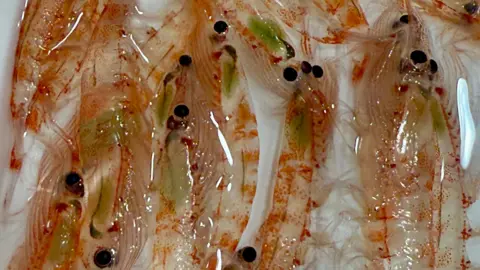
Prof Daniel J Mayor @oceanplankton A collection of Antarctic krill, Euphausia superba. The guts of many of these specimens are green, indicating that they have recently been feeding on microscopic algae (phytoplankton). Body lengths approximately 50-60mm.Prof Daniel J Mayor @oceanplankton

Antarctic krill (50-60mm) with green guts showing they’ve recently eaten algae

But warming waters as well as commercial harvesting of krill could threaten the future of zooplankton.

“Climate change, disturbance to ocean layers and extreme weather are all threats,” explains Prof Atkinson.

This could reduce the amount of zooplankton in Antarctica and limit the carbon stored in the deep ocean.

Krill fishing companies harvested almost half a million tonnes of krill in 2020, according to the UN.

It is permitted under international law, but has been criticised by environmental campaigners including in the recent David Attenborough Ocean documentary.

The scientists say their new findings should be incorporated into climate models that forecast how much our planet will warm.

“If this biological pump didn’t exist, atmospheric CO2 levels would be roughly twice those as they are at the moment. So the oceans are doing a pretty good job of mopping up CO2 and getting rid of it,” explains co-author Prof Angus Atkinson.

The research is published in the journal Limnology and Oceanography.

Thin, green banner promoting the Future Earth newsletter with text saying, “Get the latest climate news from the UK and around the world every week, straight to your inbox”. There is also a graphic of an iceberg overlaid with a green circular pattern.

Source link

- A word from our sponsors -

spot_img

Most Popular

More from Author

- A word from our sponsors -

spot_img

Read Now

Which Indian City Is Known As The City Of Honey?

Around the world, certain places stand out for their unique identities, earning special names based on what they’re famous for. Some are celebrated for their delicious food, others for rich cultures, and many for their breathtaking natural beauty. Maharajganj district in Uttar Pradesh is known as the...

First Supermoon Of 2026 To Appear Bigger And Brighter — Know When, Where, And How To Watch In India | Science & Environment News

The year 2026 kicks off with a beautiful celestial event the first full Moon of the year, known as the Wolf Moon, which will also appear as a supermoon. This stunning sight will light up the sky on January 3, 2026, appearing bigger and brighter than a...

Chris Hemsworth’s Thor sets the tone serious for ‘Avengers: Doomsday’

Chris Hemsworth is signaling a major tonal shift for Thor as Marvel Studios prepares audiences for Avengers: Doomsday, and...

PPF, Post Office FD, SSY: Govt Keeps Interest Rates On Small Savings Schemes Unchanged For Q4 FY26 | Savings and Investments News

Last Updated:December 31, 2025, 20:02 ISTPPF, NSC, SSY, KVP, Post Office Deposits: Check latest interest rates on small savings schemes for the period between January 1 to March 31 this year.Small savings schemes rate update.PPF, Post Office FD, SSY, NSC Interest Rates: The government on Wednesday, December...

Rupee outlook 2026: Why the rupee may stay under stress next year; here’s what experts say

The Indian rupee is set to face sharp and persistent volatility through 2026 as capital outflows, tariff-related trade disruptions and weak foreign investment flows continue to outweigh the country’s strong macroeconomic fundamentals, analysts and official data indicate, PTI reported.Despite steady growth and moderate inflation at...

Why This Glacier Worries Scientists the Most

new video loaded: Why This Glacier Worries Scientists the MostOur climate reporter Raymond Zhong describes how the fast-melting Thwaites Glacier of Antarctica, is like a cork in a bottle: If it starts to really disintegrate, many more glaciers around it could do the same, with major consequences...

Stock Market Holidays 2026: Are NSE, BSE Open Or Closed On December 31, January 01? | Markets News

Last Updated:December 30, 2025, 16:01 ISTWill NSE and BSE remain open on December 31 and January 1 in 2026? Check NSE, BSE holidays list for 2026?NSE Holiday 2026: Will stock market be closed on New Year? NSE Holidays 2026: As the calendar flips and investors step into...

What is happening to gas and electricity prices?

Getty ImagesTypical household energy costs will increase slightly on Thursday when the new energy price cap takes effect. Separately, the regulator Ofgem has said customer bills will rise by around £30 a year over the next six years to help fund a major investment in the UK's...

Who Is Ruby Franke? The rise and fall of the family vlogger convicted of child abuse

Your support helps us to tell the storyFrom reproductive rights to climate change to Big Tech, The Independent is on the ground when the story is developing. Whether it's investigating the financials of Elon Musk's pro-Trump PAC or producing our latest documentary, 'The A Word', which shines...

Blue Origin astronaut reveals depression after space flight backlash

A Vietnamese-American astronaut has opened up about her depression after she received a "tsunami of harassment" following the first all-female space trip since 1963 earlier this year.Amanda Nguyen - a 34-year-old scientist and civil rights activist - was part of the 11-minute Blue Origin space flight, which...

Beyoncé is now a billionaire, according to Forbes

Beyoncé once said, "It should cost a billion to look this good," and now she can afford it. The Grammy-winning artist is now a billionaire, becoming the fifth...

India’s FDI squeeze – India Today

One of the narratives of the Bharatiya Janata Party on the eve of the general election in May-June this year was that India, under the Narendra Modi government, was beginning to claim her rightful place in the world. It was growing at 7 per cent, was...