HomeScience & EnvironmentWhen does the Nasa...

When does the Nasa Moon mission launch and who are the Artemis II crew?

Pallab Ghosh,Science Correspondentand

Alison Francis
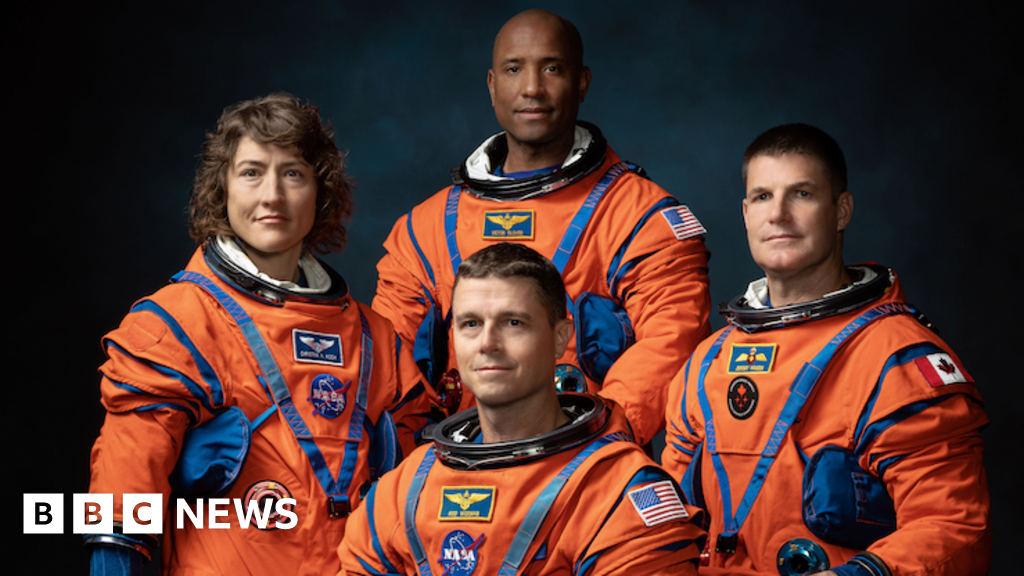
NASA The image shows four astronauts in bright orange space suits posing for a formal group portrait against a dark background. The suits are bulky with blue joints, straps and pockets, emphasising their technical design. Three astronauts stand behind while one is seated or crouching in front, all facing the camera. Their faces are blurred into smooth ovals so no expressions can be seen, keeping the focus on the uniforms. Mission-style patches and flags, including US and Canadian flags, are visible on their arms and chests. Soft, focused lighting makes the vivid orange suits stand out dramatically.NASA

Artemis II Crew: left Christina Koch, back Victor Glover (pilot), front Reid Wiseman (commander), right Jeremy Hansen

The first crewed Moon mission in more than 50 years could be launched by Nasa as soon as the first week of February.

The Artemis II mission, which will last about 10 days, could take its astronauts further into space than anyone has been before.

It aims to set the stage for an eventual human landing on the lunar surface for the first time since the Apollo missions of the 1960s and 70s.

When does Artemis II launch?

Nasa’s planned launch window opens on 6 February and runs into the spring. The US space agency wants the rocket to blast off before the end of April.

A date will not be set until final checks on its Space Launch System (SLS) rocket, the Orion capsule – which carries the crew – and ground systems are completed.

The mission will be launched from the Kennedy Space Center in Florida.

Who are the Artemis II crew and what will they be doing?

Artemis II’s crew of four includes Nasa’s commander Reid Wiseman, pilot Victor Glover and mission specialist Christina Koch. A second mission specialist, Jeremy Hansen of the Canadian Space Agency, will also be on board.

The mission involves the first crewed flight of SLS and Orion.

Once they are safely in orbit, the astronauts will test how the Orion spacecraft handles. This will involve manually flying the capsule in Earth orbit to practise steering and lining up the spacecraft for future Moon landings.

They will then head out to a point thousands of kilometres beyond the Moon to check Orion’s life‑support, propulsion, power and navigation systems.

The crew will also act as medical test subjects, sending back data and imagery from deep space.

They will work in a small cabin in weightlessness. Radiation levels will be higher than on the International Space Station, which is in low‑Earth orbit, but still safe.

On return to Earth, the astronauts will experience a bumpy return through the atmosphere and a splashdown off the west coast of the US, in the Pacific.

Will Artemis II land on the Moon?

No. This mission is to lay the ground for a lunar landing by astronauts in the Artemis III mission.

Nasa says the launch of Artemis III will take place “no earlier than” 2027. However, experts believe 2028 is the earliest possible date.

The final choice of a spacecraft to take the crew down to the lunar surface has not yet been made. It will either be SpaceX’s Starship lander or a craft designed by Jeff Bezos’s Blue Origin.

New spacesuits made by US company Axiom are also not ready.

When Artemis III finally flies, the astronauts will be heading to the Moon’s south pole.

After this, the aim is to have a sustained human presence on the Moon.

Artemis IV and V will begin building Gateway, a small space station circling the Moon. After that, there will be more Moon landings, extra sections added to Gateway, and new robotic rovers on the surface. More countries will be involved in keeping people living and working on and around the Moon for longer periods.

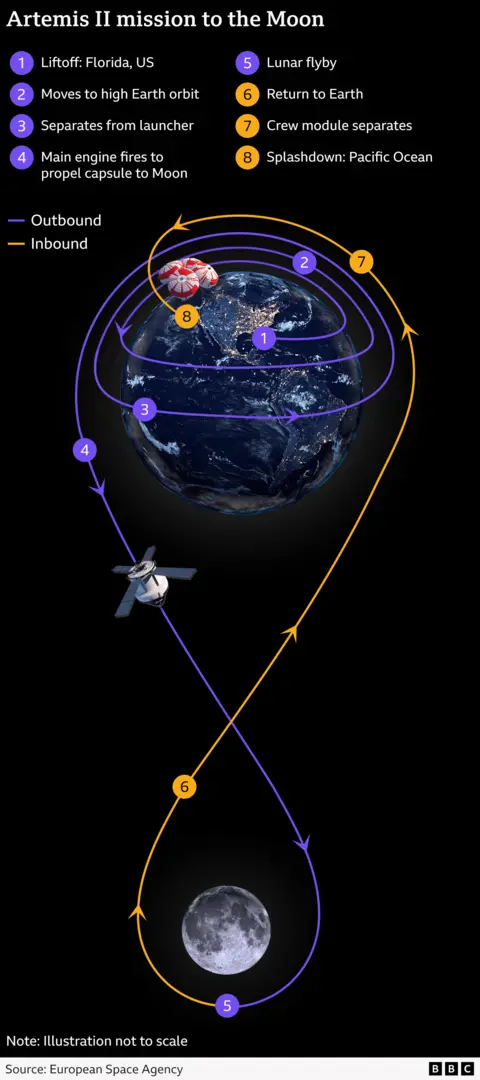
Graphic showing the Earth and Moon, with the Artemis II's figure of 8 orbital trajectory highlighted. Specific points are labelled. These are: 1. Lift off at the Kennedy Space Centre, 2. Orbit around Earth, 3. Rocket separation, 4. Main engine fires to take spacecraft to the Moon, 5. Lunar flyby, 6. Return to Earth, 7. Crew module separates, 8. Splashdown in Pacific Ocean.

When was the last Moon mission?

The last crewed Moon mission was Apollo 17, which landed in December 1972 and returned to Earth later that month.

In all, 24 astronauts have travelled to the Moon and 12 of them have walked on its surface, all during the Apollo programme.

America first went in the 1960s, primarily to beat the Soviet Union to assert its geopolitical and technological dominance. Once that goal was achieved, political enthusiasm and public interest ebbed, as did the money for future Moonshots.

Artemis grew out of a desire to return humans to the Moon, this time for a longer-term presence built around new technology and commercial partnerships.
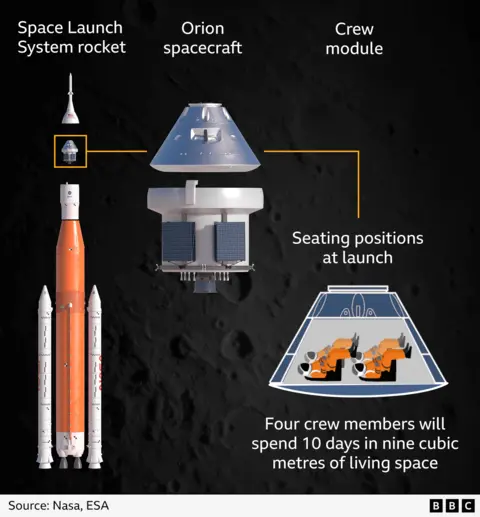
An illustration showing how the Artemis II astronauts will be arranged in the Orion crew module at launch. The four astronauts sit reclined, in two rows of two, facing up with their backs to the ground. During the mission the four crew members will spend 10 days in about nine cubic metres of living space. The image shows that the crew module makes up about half of the Orion spacecraft - with the service module being around the same size - and that, on the launchpad, Orion is only a small section of the 98m (320ft) Space Launch System rocket.

Do other countries plan to send astronauts to the Moon?

Several other countries have ambitions to put people on the Moon in the 2030s.​

European astronauts are set to join later Artemis missions and Japan has also secured seats.

China is building its own craft, targeting a first landing near the Moon’s south pole by 2030.

Russia continues to talk about flying cosmonauts to the surface and building a small base sometime between about 2030 and 2035. Sanctions, funding pressures and technical setbacks mean its timetable is highly optimistic.

India has also expressed ambitions to one day see its own astronauts walking on the Moon.

Following the success of Chandrayaan 3’s landing near the lunar south pole, India’s space agency set out a goal of sending astronauts to the Moon by about 2040. This would be part of a push to move its human spaceflight programme beyond low Earth orbit.

Additional reporting by Kevin Church.

Source link

- A word from our sponsors -

spot_img

Most Popular

More from Author

2026 is the ‘year of execution’ amid turnaround plan

Stellantis CEO Antonio Filosa speaks during an event in Turin, Italy,...

UK secures record supply of offshore wind but price rises

Mark Poynting,Climate researcherandJustin Rowlatt,Climate editorGetty ImagesThe UK has awarded contracts to...

- A word from our sponsors -

spot_img

Read Now

2026 is the ‘year of execution’ amid turnaround plan

Stellantis CEO Antonio Filosa speaks during an event in Turin, Italy, Nov. 25, 2025.Daniele Mascolo | ReutersDETROIT — Stellantis CEO Antonio Filosa views 2026 as an execution year for the embattled maker of Jeep, Ram and Dodge vehicles in the U.S. after years of market share declines.Filosa...

UK secures record supply of offshore wind but price rises

Mark Poynting,Climate researcherandJustin Rowlatt,Climate editorGetty ImagesThe UK has awarded contracts to build a record amount of offshore wind as part of its efforts to grow the country's clean electricity.The projects span England, Scotland and Wales, including part of what could become the world's largest offshore wind farm,...

Actor Timothy Busfield turns himself in following child sex abuse allegations in New Mexico

Timothy Busfield turned himself into police on Tuesday after authorities in New Mexico issued an arrest warrant for the director and Emmy Award-winning actor accused of child sex abuse.A spokesperson for the Albuquerque Police Department confirmed to CBS News that Busfield had surrendered....

Bulls return as PSX surges over 1,500 points

Investors returned to buying mode, signalling a turnaround after recent corrective sessions. ...

The surprising difference between a sprained ankle and a twisted ankle

Your support helps us to tell the storyFrom reproductive rights to climate change to Big Tech, The Independent is on the ground when the story is developing. Whether it's investigating the financials of Elon Musk's pro-Trump PAC or producing our latest documentary, 'The A Word', which shines...

Complete iPhone and Android privacy protection guide for mobile security

NEWYou can now listen to Fox News articles! Protecting your privacy doesn’t require advanced tools or technical expertise. Some of the most effective protections are already built into your phone; you just need to know where to look.These five privacy tips show you exactly how...

Glen Powell attends Golden Globes afterparty with beau Michelle Randolph

Glen Powell and Michelle Randolph gave their romance a quietly public moment following the 2026 Golden Globes, stepping out...

Electricity tariff to go down by 93 paisas

The federal government slashed electricity prices by 93 paisa under the head of fuel adjustment charges (FCA) with effect from November 2025, but kept the basic tariff unchanged. According to details, the...

This is the easiest way to remove stickers from glass bottles — a simple hack that works in seconds! |

Yes, you read that right! For most of us, removing stickers from glass bottles is often irritating, messy and a tedious task. And let’s just not talk about how much time the process consumes. But even after so much time and effort, there’s no guarantee...
